Modern printing technologies
Technologies
Modern printing technologies
Innovation and new technologies
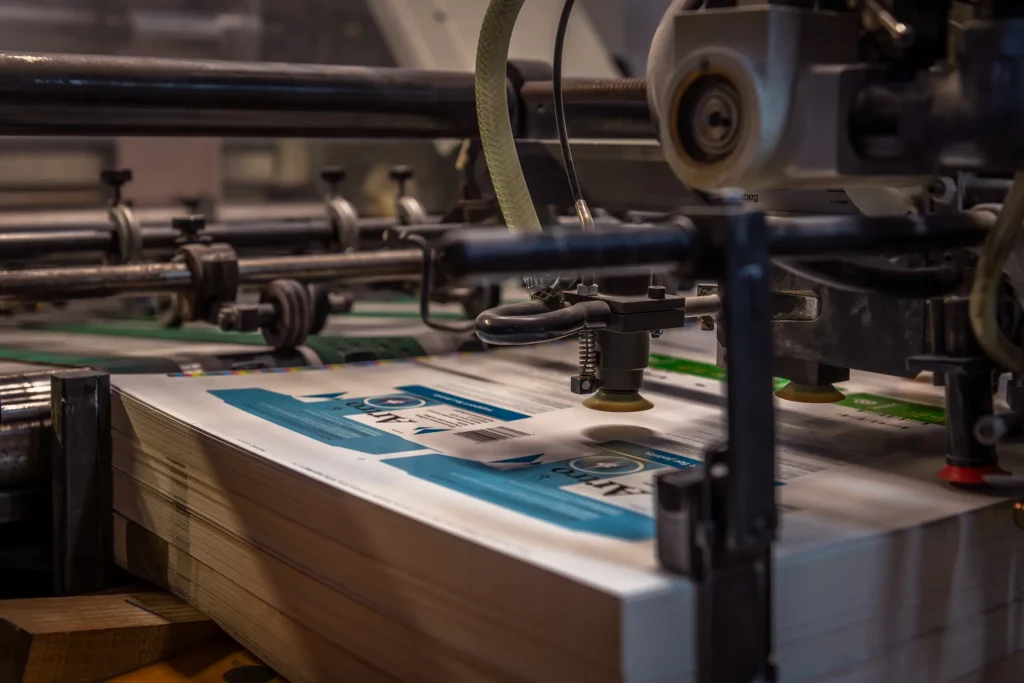
Multipress Printing House is located in a newly built production facility, where modern machinery plays a key role. Technology has always been our priority and a way to provide our customers with ever-improving conditions in terms of quality, production scale, and order fulfillment speed.
For over 20 years, Multipress Printing House has been consistently investing in modern technologies, developing its machine park, and implementing numerous innovations.
Multipress has a modern graphic studio and a research and development department where innovative solutions in the field of design, printing techniques and finishing, as well as substrates and materials used, are developed and tested.
Modern printing technologies
Full production automation
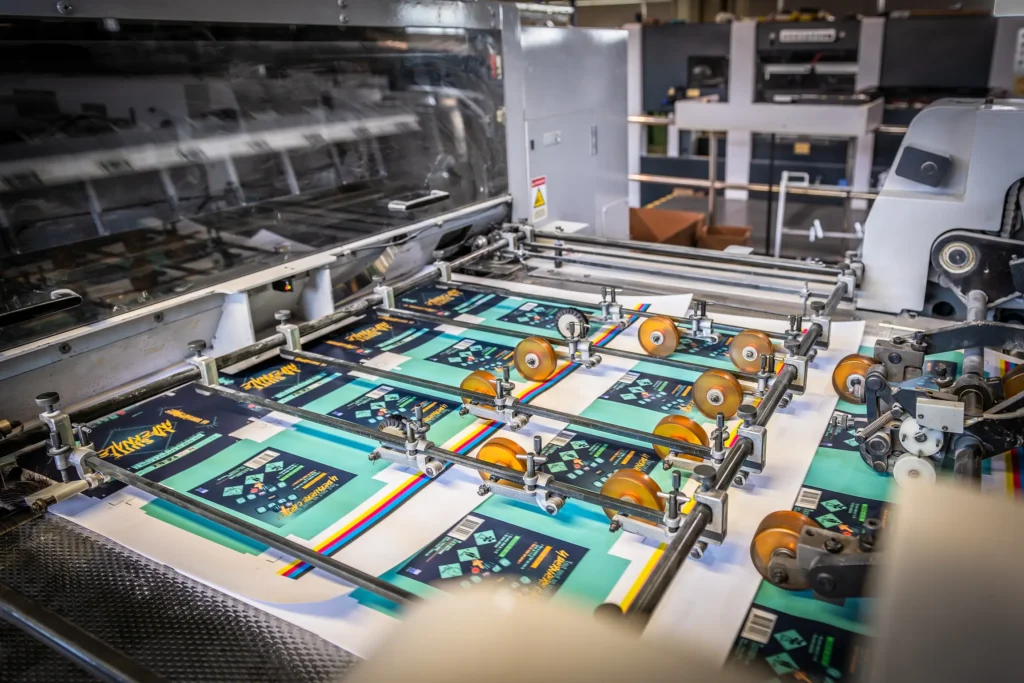
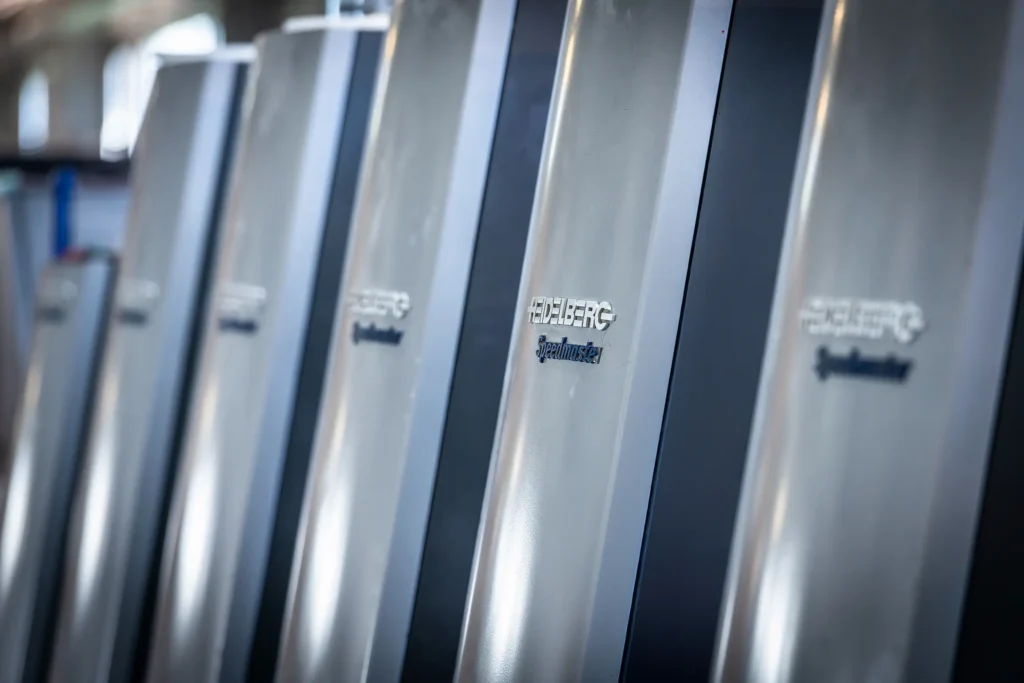
The packaging and label production processes are fully automated. Offset printing is performed on full-format 6-color machines with UV ink printing capabilities, and print quality is based on Heidelberg’s computerized and electronic color management system. This system is particularly important for ensuring repeatability in high and cyclical print runs. The printing house also has a flexographic department for the production of self-adhesive labels.
The Multipress printing house is comprehensively equipped with post-press machines enabling a high degree of processing, which use the latest technological solutions from manufacturers such as Sanwa (Japan), Heiber & Schröder (Germany) and Gietz (Switzerland).
our offer - Everything your brand needs
Discover our technology
Offset printing
Advanced print control
High quality and accurate color reproduction throughout the entire printing process at Multipress Printing House are controlled by state-of-the-art Image Control measuring devices from Heidelberg (50 million density and color measurement points) and Impress Control (in-line print control), which communicate with the printing machines via computer. This allows us to achieve high repeatability of prints and faithful reproduction of proof colors.
Offset printing – screening
The choice of screen type and its parameters has a significant impact on the final print result. Multipress Printing House has the latest amplitude (linear), frequency (stochastic screen) and hybrid (amplitude-frequency) screening systems from Heidelberg.
Offset printing with UV inks on laminated substrates
Multipress offers offset printing using UV technology. This involves printing with UV-curable inks on non-absorbent substrates as well as on paper. Such substrates include, among others, metallized papers, plastic substrates, and foil substrates. Thanks to this printing technique, the material coming off the printing machine does not require long drying times before further post-press processing.
Flexographic printing
Multipress Printing House has a flexographic department for the production of self-adhesive labels with a high degree of processing. Production is carried out using a modern 8-color UV flexographic line with cold stamping, UV varnishing, and die cutting in a single pass.
Double-sided printing in a single pass is also possible thanks to the web rotation function, as well as rotary embossing and sheet cutting with slitting. In addition, a major advantage of the flexographic department at Multipress Printing House is the possibility of rotary printing in A3 format.
Painting
Purposes of varnishing
In offset printing, various varnishing methods are used to improve the appearance and durability of prints. Dispersion varnishing – increases scratch resistance, protects the print; we use glossy, matt, semi-matt or soft-touch varnishes. UV varnishing – used similarly to dispersion varnish, but cured with UV radiation, which ensures faster drying and increased resistance to mechanical and chemical damage, and increases the gloss of the printed surface. Selective UV varnishing – used on specific areas of the print, creating a difference in gloss, which can emphasise important elements of the design. Hybrid varnish, also known as drip-off varnish, is an increasingly common but still distinctive way of refining printed materials. It is used in modern offset printing technology. Hybrid varnishing – drip-off – means obtaining two visually different varnishes on one printed surface, one of which is glossy and the other matt.
UV varnishing
What are UV varnishes?
UV varnishes are varnishes cured by UV rays. They can be divided into glossy and matte, adhesive-friendly, suitable for hot-stamping foil application, cationic varnishes used in flexography, and physiologically harmless varnishes, suitable for food packaging.
UV Varnish Application Methods
- varnishing machines
- water unit in offset printing machines
- ink unit in offset printing machines
- screen printing machines
- flexographic machines (UV flexo)
3D UV Varnishes
3D UV Varnishes are a type of UV varnishing that uses a varnish that “swells” as a result of drying with UV radiation.
Advantages of 3D varnishing:
- 3D effect
- Cheaper alternative to embossing (no die costs)
- Can be combined with foil stamping technology
- Can be used for Braille writing
Hybrid varnishing
What is hybrid varnishing?
Hybrid varnishing, also known as drip-off varnishing, is an increasingly common yet distinctive method of refining printing. It is used in modern offset printing technology. Hybrid varnishing involves obtaining two visually different varnishes on a single surface, one of which creates glossy surfaces and the other matte surfaces.
What is hybrid varnishing?
Glossy surfaces act as pure UV varnish, while to achieve a matte surface, the UV varnish must be mixed with the offset varnish at the appropriate time and location during the application process. The offset varnish used for this purpose must have special properties to create a roughened effect, i.e., a matte surface, upon contact with the UV varnish.
Effects of drip-off varnishing
The roughness of the matte surface is determined by the ruling of the roller used to apply the UV varnish. Therefore, matte surfaces can have different gradations, which additionally allows for matching the matte surface to the design’s graphics (e.g., a fruit such as an orange may have a rougher varnish, while a banana may have a smoother one). Only one degree of gradation (roughness) of the matte part can be applied to a single sheet surface.
Gilding Cold Stamping Flexo
What is Cold Stamping?
Cold stamping is a printing technique using cold stamping foil and a suitable adhesive. The adhesive is applied using flexography precisely in the areas desired for foil enhancement. After pressing the “printed” adhesive onto the adhesive layer of the foil, the dye is removed from the carrier layer. Flexography also requires UV lamps to activate the adhesive. Cold stamping is used for print enhancement, marking, and product protection (especially holographic foils).
Printing and Cold Stamping in One Line
Multipress Printing House has the technology to apply foils (metallic, holographic, and others) inline, in conjunction with the printing process. This makes the entire process time- and cost-effective. Thanks to the ability to screen foil elements (tone transitions) with the option of immediately covering them with paint, we have a very wide range of metallic effects that refine the final product.
Hot Stamping Gilding
What is Hot Stamping?
Hot stamping, also known as thermal printing, is a printing technique using hot stamping foil and convex dies made of a heat-conducting material. Hot stamping is used for print refinement, decorating objects, marking, and print security (especially holographic foils).
Hot stamping foil consists of several layers: a release layer, a varnish layer, a vacuum-sprayed aluminum layer, and an adhesive layer. The die is heated to approximately 100°C. When the die is in contact with the PET foil, the adhesive layer heats up, the adhesive activates in the areas corresponding to the drawing on the die, and, along with the appropriate portion of the varnish layer and aluminum layer, remains on the hot-stamped surface.
Structured matrix
A structured matrix is a type of matrix used in hot stamping, whose embossing surface is covered with a lightly outlined drawing or graphic motif. In the hot stamping process, in addition to the normal application of foil, creating an image framed by the edges of the matrix (standard hot stamping), the surface of the print being refined is also shallowly embossed with structured scratches, thus giving the foil a texture that reflects the matrix’s structural pattern.
Stamping and punching
Embossing
Embossing, also known as “dry embossing,” is a type of printing refinement that involves creating a three-dimensional (2.5D) pattern in the embossed material (usually paper, often plastics, leather) by pressing with a die/machine, usually to highlight a previously printed pattern (text, logo, decorative element).
Embossing is performed at ambient temperature, or the die is heated to several dozen degrees Celsius. This allows the embossed material to retain its deformation to a greater extent after the die releases. Sometimes even higher temperatures are used to further discolor the embossed material (e.g., leather).
3D Embossing
This is embossing using special multi-level dies. These dies are most often created through CNC machining (digitally controlled milling machines). The final result is an embossed three-dimensional image.
Die-cutting
Die-cutting, commonly known as “die-cutting,” is a bookbinding process that involves cutting a stack of sheets of paper, cardboard, paperboard, or other similar substrate into the desired shape for a package or label with complex shapes that cannot be achieved using standard guillotine cutting. Die-cutting is also a plastic processing method. Cutting is performed using a die with a specially shaped blade, which is pressed perpendicularly into the substrate with great force.
Pasting windows
Packaging with Windows
Cartons with a visible product are becoming increasingly popular. A window allows the customer to view the finished product and arouse their interest. Therefore, our range of services includes the creation of packaging with flat and creased foil windows, in any shape and color.